• Forging Tongs

    Adirondack Folk School 51 Main St., Lake Luzerne, NY, United States

    Next to your hammer, the most important tool when working in the forge is your tongs! Properly made tongs will hold work securely and safely, making your forging experience more enjoyable. In this class you'll learn how to make flat jaw, bolt, and lip law tongs and if time allows perhaps more.

  • Sheepsfoot Knife and Marlin Spike with Sheath

    Adirondack Folk School 51 Main St., Lake Luzerne, NY, United States

    In this class you'll learn to forge a knife featuring a sheepsfoot blade with a paracord wrapped handle, crafted from mild steel and hardened using super quench. The sheepsfoot blade, known for its straight edge and rounded tip, is ideal for clean controlled cuts without the risk of accidental punctures- perfect for slicing rope or working on confined spaces. You'll also forge a marlin spike; a pointed metal tool designed to separate rope strands and untie stubborn knots. It's an essential tool for sailors and anyone who works with lines, and it's especially useful when splicing multi-stranded ropes. To complete the set, we'll make a belt sheath from vegetable-tanned cowhide, custom-fitted to hold both tools securely. This practical combo is a must-have for nautical enthusiasts and outdoorsmen alike.

  • Sheepsfoot Knife and Marlin Spike with Sheath

    Adirondack Folk School 51 Main St., Lake Luzerne, NY, United States

    In this class you'll learn to forge a knife featuring a sheepsfoot blade with a paracord wrapped handle, crafted from mild steel and hardened using super quench. The sheepsfoot blade, known for its straight edge and rounded tip, is ideal for clean controlled cuts without the risk of accidental punctures- perfect for slicing rope or working on confined spaces. You'll also forge a marlin spike; a pointed metal tool designed to separate rope strands and untie stubborn knots. It's an essential tool for sailors and anyone who works with lines, and it's especially useful when splicing multi-stranded ropes. To complete the set, we'll make a belt sheath from vegetable-tanned cowhide, custom-fitted to hold both tools securely. This practical combo is a must-have for nautical enthusiasts and outdoorsmen alike.

  • Forging a Chef’s Knife

    Adirondack Folk School 51 Main St., Lake Luzerne, NY, United States

    This class is taught by renowned instructor and the very first winner of History Channel's Forged in Fire, Matthew Parkinson. The chef's knife is the most used knife in almost any home. These iconic knives help to create meals for family and loved ones. Well-made kitchen knives can last a lifetime and this class will give you the opportunity to create one of your very own. In this two-day class students will make their own chef's knife from high carbon steel. All aspects of bladesmithing will be covered, from forging the blade to shaping, then heat treating, grinding, and polishing, making and fitting a wooden handle and finally, sharpening - with very special attention given to the design and geometry of this kind of knife. This class is intended as an introductory bladesmithing class, but some forging experience is helpful.

  • Forging a Chef’s Knife

    Adirondack Folk School 51 Main St., Lake Luzerne, NY, United States

    This class is taught by renowned instructor and the very first winner of History Channel's Forged in Fire, Matthew Parkinson. The chef's knife is the most used knife in almost any home. These iconic knives help to create meals for family and loved ones. Well-made kitchen knives can last a lifetime and this class will give you the opportunity to create one of your very own. In this two-day class students will make their own chef's knife from high carbon steel. All aspects of bladesmithing will be covered, from forging the blade to shaping, then heat treating, grinding, and polishing, making and fitting a wooden handle and finally, sharpening - with very special attention given to the design and geometry of this kind of knife. This class is intended as an introductory bladesmithing class, but some forging experience is helpful.

  • Open Forge Night

    Adirondack Folk School 51 Main St., Lake Luzerne, NY, United States

    Interested in blacksmithing but unsure how to start? Open Forge Night is the place for you! Every third Wednesday of the month during our blacksmithing season, come see demonstrations by expert blacksmith Steve Gurzler. Observing the demonstration is free and open to the public. If you want to try your hand at blacksmithing there is a $20 fee to cover the cost of materials. Safety precautions must be followed - including hard shoes with no open toes, long pants, goggles (supplied) and gloves (supplied).

  • National Curriculum Level 1

    Adirondack Folk School 51 Main St., Lake Luzerne, NY, United States

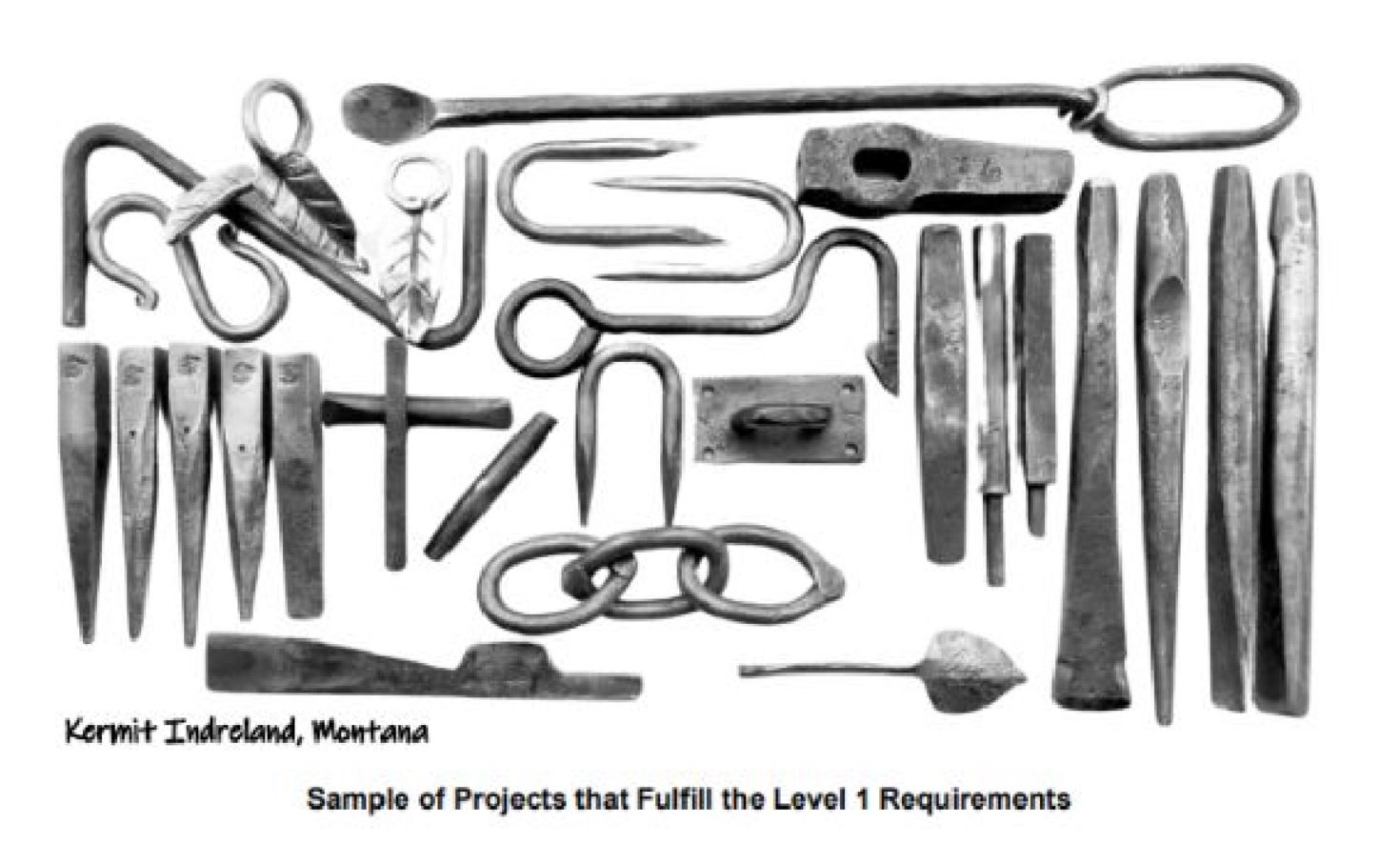
    The National Curriculum offers a step-by-step progression through three levels of fundamental blacksmithing skills. Certification signifies that a smith has demonstrated mastery of a specific set of skills, increasing in complexity with each level: Level I (beginner), Level II (intermediate), Level III (advanced). Level I is the first level of the curriculum and is designed as a guide through beginning blacksmithing techniques. Starting with safety, Level I then moves into core skills and techniques, including tapering, bending, forging and heat-treating hand tools, punching and drifting, basic blacksmithing math, forging to dimension, forge-welding, and creating tenons. It culminates in a final project, the Gate Latch, designed to test the student on these skills. Upon completion of Level I, students will have confidence in the most essential blacksmithing skills and be able to forge a wide variety of projects. The program is designed to provide a solid foundation within the craft. To earn certification, the student needs to successfully complete the projects and techniques as outlined in the checklist in the Level I Student Packet. This is found on the website abana.org The checklist allows students and instructors to keep track of progress. ABANA will accept the recommendation from an Affiliate?s Education Program Chair or the judgment of a Certified Level I Instructor that qualifies a student as having passed Level I.
  • National Curriculum Level 1

    Adirondack Folk School 51 Main St., Lake Luzerne, NY, United States

    The National Curriculum offers a step-by-step progression through three levels of fundamental blacksmithing skills. Certification signifies that a smith has demonstrated mastery of a specific set of skills, increasing in complexity with each level: Level I (beginner), Level II (intermediate), Level III (advanced). Level I is the first level of the curriculum and is designed as a guide through beginning blacksmithing techniques. Starting with safety, Level I then moves into core skills and techniques, including tapering, bending, forging and heat-treating hand tools, punching and drifting, basic blacksmithing math, forging to dimension, forge-welding, and creating tenons. It culminates in a final project, the Gate Latch, designed to test the student on these skills. Upon completion of Level I, students will have confidence in the most essential blacksmithing skills and be able to forge a wide variety of projects. The program is designed to provide a solid foundation within the craft. To earn certification, the student needs to successfully complete the projects and techniques as outlined in the checklist in the Level I Student Packet. This is found on the website abana.org The checklist allows students and instructors to keep track of progress. ABANA will accept the recommendation from an Affiliate?s Education Program Chair or the judgment of a Certified Level I Instructor that qualifies a student as having passed Level I.
  • National Curriculum Level 1

    Adirondack Folk School 51 Main St., Lake Luzerne, NY, United States

    The National Curriculum offers a step-by-step progression through three levels of fundamental blacksmithing skills. Certification signifies that a smith has demonstrated mastery of a specific set of skills, increasing in complexity with each level: Level I (beginner), Level II (intermediate), Level III (advanced). Level I is the first level of the curriculum and is designed as a guide through beginning blacksmithing techniques. Starting with safety, Level I then moves into core skills and techniques, including tapering, bending, forging and heat-treating hand tools, punching and drifting, basic blacksmithing math, forging to dimension, forge-welding, and creating tenons. It culminates in a final project, the Gate Latch, designed to test the student on these skills. Upon completion of Level I, students will have confidence in the most essential blacksmithing skills and be able to forge a wide variety of projects. The program is designed to provide a solid foundation within the craft. To earn certification, the student needs to successfully complete the projects and techniques as outlined in the checklist in the Level I Student Packet. This is found on the website abana.org The checklist allows students and instructors to keep track of progress. ABANA will accept the recommendation from an Affiliate?s Education Program Chair or the judgment of a Certified Level I Instructor that qualifies a student as having passed Level I.

  • National Curriculum Level 1

    Adirondack Folk School 51 Main St., Lake Luzerne, NY, United States

    The National Curriculum offers a step-by-step progression through three levels of fundamental blacksmithing skills. Certification signifies that a smith has demonstrated mastery of a specific set of skills, increasing in complexity with each level: Level I (beginner), Level II (intermediate), Level III (advanced). Level I is the first level of the curriculum and is designed as a guide through beginning blacksmithing techniques. Starting with safety, Level I then moves into core skills and techniques, including tapering, bending, forging and heat-treating hand tools, punching and drifting, basic blacksmithing math, forging to dimension, forge-welding, and creating tenons. It culminates in a final project, the Gate Latch, designed to test the student on these skills. Upon completion of Level I, students will have confidence in the most essential blacksmithing skills and be able to forge a wide variety of projects. The program is designed to provide a solid foundation within the craft. To earn certification, the student needs to successfully complete the projects and techniques as outlined in the checklist in the Level I Student Packet. This is found on the website abana.org The checklist allows students and instructors to keep track of progress. ABANA will accept the recommendation from an Affiliate?s Education Program Chair or the judgment of a Certified Level I Instructor that qualifies a student as having passed Level I.

  • National Curriculum Level 1

    Adirondack Folk School 51 Main St., Lake Luzerne, NY, United States

    The National Curriculum offers a step-by-step progression through three levels of fundamental blacksmithing skills. Certification signifies that a smith has demonstrated mastery of a specific set of skills, increasing in complexity with each level: Level I (beginner), Level II (intermediate), Level III (advanced). Level I is the first level of the curriculum and is designed as a guide through beginning blacksmithing techniques. Starting with safety, Level I then moves into core skills and techniques, including tapering, bending, forging and heat-treating hand tools, punching and drifting, basic blacksmithing math, forging to dimension, forge-welding, and creating tenons. It culminates in a final project, the Gate Latch, designed to test the student on these skills. Upon completion of Level I, students will have confidence in the most essential blacksmithing skills and be able to forge a wide variety of projects. The program is designed to provide a solid foundation within the craft. To earn certification, the student needs to successfully complete the projects and techniques as outlined in the checklist in the Level I Student Packet. This is found on the website abana.org The checklist allows students and instructors to keep track of progress. ABANA will accept the recommendation from an Affiliate?s Education Program Chair or the judgment of a Certified Level I Instructor that qualifies a student as having passed Level I.

  • Handforged Cooking Utensils

    Adirondack Folk School 51 Main St., Lake Luzerne, NY, United States

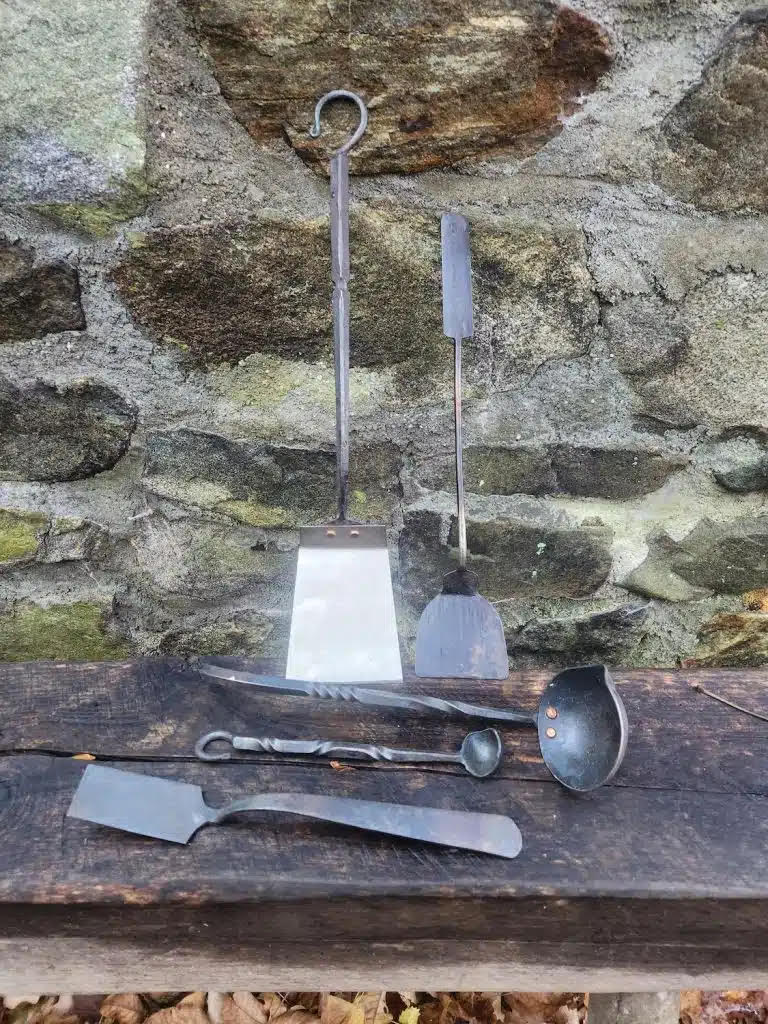
    Come learn fundamental forging techniques while making functional cooking utensils great for the BBQ or kitchen. In this beginner workshop we will explore both one piece forgings as well as two piece riveted construction. You will learn simple hand forging techniques at the anvil and food safe metal finishes.